Student Employment

Several students smiling

OCC Student Employment Logo

Development | Support | Intentionality | Excellence

Hire a Hog: Become a Student Employee Supervisor!

We believe that students are a critical part of our campus workforce and that they can do excellent work. If you are considering developing a student position within your department, talk to your unit supervisor and human resources team and then use our resources below to guide the process. Consider the needs of your department and how students can fill the gap!

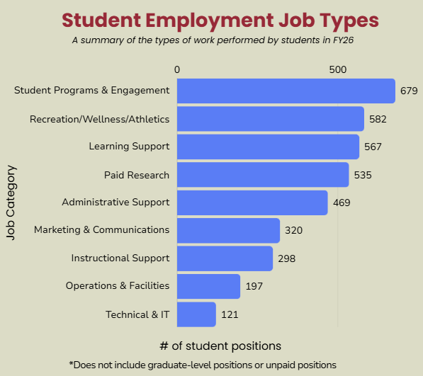
Students can do more than you might think! These are all the types of positions that current student employees are in right now.

A summary of the types of work performed by students in FY26

Types of Positions

  • Part-Time Student Employee – Temporary, part-time position held by a currently enrolled student that supports university operations, student services, teaching, research, and more.
  • Internship - Temporary, structured work experience that provides an enrolled student with professional development and exposure to a specific career or industry.
  • Graduate Assistantship – Part-time position held by a graduate student with operational, teaching, or research responsibilities. Most graduate assistants are compensated through appointment-based stipend rather than an hourly wage.

Make sure to talk with your unit supervisor and human resources team – they will know the feasibility of your plan and how to put it into action!

What to Consider

Budget: Budgeting hourly student wages is an art, not a science – budget for the hours you need to cover, not a certain number of employees, and consider how different funding options affect your budget planning.

Funding: As noted in the previous section, how your position is funded is an important consideration.

  • Federal Work Study Funds
    • A financial aid program that helps students earn money through part-time jobs. Departments can hire students with a Federal Work Study award to support their operations at a reduced cost, since the program covers a portion of the student’s wages.
    • Work Study will fund 75% of a student's wages! Your department will cover the remaining 25%.
    • Federal Work Study funds may be used to fund Extra Help hourly positions.
    • Contact: Erin Wooldridge (ewooldri@uark.edu), UARK Federal Work Study Coordinator – Office of Financial Aid
  • Departmental Funds
    • Departmental budget allocated to pay student wages.
    • Departmental funds may be used to fund Extra Help (hourly), Period Activity Pay (stipend), and graduate assistantship stipends.

Supervision: Consider supervisor’s capacity to support student employees – having weekly time to observe, coach, and provide feedback is important for a meaningful student employment experience.

Position Design: Intentionally design the student employee’s experience by developing a Career-Ready Job Description through attending a workshop or utilizing the resources linked.

Thinking you might benefit from having student employees but aren't sure where to start? Book a consultation appointment with Michelle and Cecilee: Consultation Appointment Booking Link

Hired Hogs: Current Supervisor Resources & Information

For general HR information and policies you can visit Human Resources’ online resource hub.

Utilize our Student Employment Calendar that will provide you with important academic and employment dates, student stresses and events, monthly reminders and links to resources.

Preparation Mindset:

  • Use fresh eyes to consider how your position can support the whole student and assist in their career development.
  • Intentional forward-thinking and organized planning allow you and your students to do excellent work!

Review Your Job Description: Every time you want to hire, you should review your job description to ensure that it is the most up-to-date and accurate representation of the position you are offering.

  • Career-Ready Job Descriptions – Align the position description to the UA Career-Ready Skills to identify the transferable skills that can be learned in the position – attend a workshop or utilize the resources linked to align your position to the UARK common language.

Plan the Employment Experience: A student's experience starts from the moment they see your job posting. Planning a student's full experience should start before you post a position. Consider your recruiting and hiring timeline, where/how they will work, standards and expectations, review your Plan the Employment Experience: A student's experience starts from the moment they see your job posting. Planning a student's full experience should start before you post a position. Consider your recruiting and hiring timeline, where/how they will work, review your onboarding and training processes, and determine strategies for retaining and celebrating their work!

  • Utilize our resources below to plan for each phase of the student employee lifecycle!

Career-Ready Job
Description Box Folder

See "Events" section for upcoming Career Ready Job Description Workshops

Recruiting Mindset:

  • Start building a culture of learning! Communicate early and often how your position will benefit the student's development.
  • Remember, this could be a student’s first time going through the employment process. Detailed and clear communication will help students navigate new and potentially unfamiliar processes.

Advertising Your Job

We encourage all campus employers to post all student job openings so eligible students have the opportunity to apply. Student positions may be posted through either Workday or Handshake, depending on how your department wants to collect applications.

No matter which application method you choose, student job postings will be visible in Handshake, UARK’s central student jobs platform. The main difference is where students submit their applications.

Option 1: Workday Application + Workday Hiring Process

Best for departments that want applications collected directly in Workday.

  1. HR posts the position in Workday.
  2. The position is automatically shared to Handshake for student visibility.
  3. Students apply through Workday.
  4. The selected student is hired through Workday processes.
  5. If applicable, confirm Federal Work Study eligibility with Financial Aid.

Option 2: Handshake Application + Workday Hiring Process

Best for departments that recruit frequently or Workday recruiting does not fit their needs (e.g., student employees assist with hiring, position is scholarship-based, etc.)

  1. The position is posted in Handshake by hiring manager (or HR).
  2. Students apply through Handshake.
  3. The supervisor reviews applicants in Handshake and selects a candidate.
  4. The selected student completes the Workday Evergreen application for hiring.
  5. Federal Work Study eligibility can be viewed within Handshake.

Request a Handshake account using the link to the right!

What is Handshake?

Handshake is UARK’s student job board. It offers a central, convenient place for students to find on-campus jobs, internships, and post graduation jobs. For on-campus employment:

  • Students can filter by “on-campus” within the platform.
  • Any jobs posted in Workday will be automatically cross-posted to Handshake by HR.
  • Faculty and staff who would like to post jobs can request Handshake accounts through the request link to the right.

Register for the UARK Part-Time Jobs Fair

Each Fall and Spring, Career Connections hosts a job fair for you to connect face-to-face with hundreds of students who are seeking part-time employment. Keep an eye on the latest registration and fair dates by using the link on the right!

More information and resources coming soon.

Day-to-Day Mindset

  • Day-to-day tasks, while sometimes mundane, are those that build transferable skills – give them space to reflect turns them from mundane to meaningful!
  • Simple processes are easy to get relaxed on, but they make the biggest impact when forethought and consistency are applied. Remember their impact and always keep striving for ways to improve you and the students’ experience day-to-day.

Operations

  • Payroll Information
    • Student employees are paid on a biweekly basis, and it is imperative that they submit hours and you approve them in Workday by the appropriate deadlines every two weeks. View the Payroll calendar and find a system to remind yourself.
    • It is your responsibility to ensure your student employees submit time in a timely manner, and that they are approved before deadlines.
    • Help Reports in Workday
      • Search “Hour Entered but Not Submitted” in Workday to see which students have entered time but not fully submitted for approval.
      • Search “Hours Submitted but Not Approved” in Workday to see any hours you missed approving.
    • For questions, email payroll@uark.edu
  • Scheduling
    • There is no single scheduling platform or method that is widely adopted – how you schedule is dependent on how large your team is, budget to purchase software and more. Examples of current methods across campus are below:
      Platform Fee Used by
      SubItUp Paid Unviersity Recreation + Wellness (UREC) and Student Success
      Microsoft Shifts Free
      Lettuce Meet Free Offices of Career Connections (OCC)
      Microsoft Excel Free Offices of Career Connections (OCC), and Center for Community (CCE)
  • Inclement Weather Policy
    • Hourly employees designated as "Essential On-Site Personnel" who report to work as regularly scheduled when the university has shifted to inclement weather operations will receive inclement weather pay as defined in the policy.
    • Hourly employees not designated as "Essential On-Site Personnel" are not eligible for inclement weather pay and are to work remotely, if possible with supervisor approval. Those who miss work due to inclement weather and do not work remotely will not be paid for time missed.
    • Federal Work Study funds cannot be used to pay students on inclement weather days for hours they were scheduled but did not work.

Student Support

In your day-to-day, you may find that a student employee needs support outside of the job. Here are several resources for support:

  • One Stop Student Guide: A student’s (and your) comprehensive guide to campus resources.
  • Well-Being Website: Utilize this website for information on well-being-focused resources for students who need support.
  • Reporting Website - Report student concerns that need additional university resources and support.

More information and resources coming soon.

Recognition Mindset:

  • Build relationships that allow you to recognize students holistically, not just for their job performance. Recognition can be big and small!
  • Recognition can help students understand their strengths and be a powerful motivator for doing excellent work in the future.
  • Recognition and gratitude are easily lost when operations become busy. Planning and prioritizing consistent recognition will help you to keep it alive even in operationally difficult environments.

Central Recognition

  1. Student Employee of the Quarter – We recognize outstanding undergraduate and graduate students who have demonstrated exemplary performance, dedication, and impact during the quarter. Any faculty/staff member may nominate a student employee.
  2. Student Employee of the Year – All quarterly winners will be entered into the pool for the Student Employee of the Year awards.
  3. National Student Employment Week – A week of events in April planned by the student employment team to celebrate and recognize the hard work of all student employees across campus.

Supervisor or Departmental Recognition: Find ways to recognize your students whether through formal programs or informal shoutouts – look through our list of ideas:

  1. Academic Success Recognition
  2. Staff Meeting Shout Outs/Good Things
  3. Quarterly or Monthly Student Employee Awards
  4. National Student Employment Week activities and rewards
  5. End of Year celebrations and awards

Evaluation Mindset:

  • Think of evaluations as an opportunity for your student employee to grow. Be understanding and help build their confidence in areas where they are doing well.
  • To give a good evaluation, you need to observe and spend time with your student employees. Give yourself and the student ample time to fill out and review their evaluation.

Best Practices

  • Utilize our Career-Ready Evaluation Template – if you have aligned your job description to the UA Career-Ready Skills you can utilize the aligned skills in the evaluation process!
  • Evaluations should include an in-person conversation as a component of the process.
  • Students should be aware of the evaluation criteria and job standards at the beginning of their employment.

Suggested Timeline

  • Typically a 6-week process (including preparation, conducting evaluations, and administrative follow-up).
    • Summer: Typically July and August
    • Fall: Typically October and November
    • Spring: Typically March and April

Evaluation Steps

  1. Fill out the evaluation for the student employee
    1. Consider having the student complete a self-evaluation using the same template.
  2. Save the evaluation and provide the student for review prior to meeting.
  3. Conduct an in-person conversation using the evaluation as a guide for conversation. Sharing with the student the reasoning behind the ratings you provided.
  4. After the conversation, make any notes or changes from your meeting and then have both yourself and the student sign the evaluation.
  5. Save the signed evaluation in an easily accessible place for your records and any potential raises.

Tips for Having Difficult Conversations

  • Center relationship-building in your employment process – if you know your student employees and how they take feedback and communicate, you are more likely to feel more confident during this conversation.
  • Ask their perspective before you give constructive feedback. Often our students are aware of where they fell short, letting them share first allows you to more easily broach the subject.
  • When giving constructive feedback, make sure you have direct and specific examples to help illustrate what you mean to the student. Additionally, have strategies and suggestions for ways to improve or develop in those areas.
  • Recognize that it may be uncomfortable, and this is normal!

Merit Raises & Promotions

  • Recognize your student’s hard work through potential merit raises and promotions. Make sure that you tie either of these options to positive evaluations.
  • Talk with your human resources team about the proper steps you can take to increase pay or promote a student employee.

Development Mindset:

  • Development is not just adding additional training, it can be as simple as giving students space to reflect on the work they are doing and how it relates to their future.
  • Every student is different; meet them where they are. This helps you tailor your developmental efforts and assists them in feeling connected to the activities.

UA Career-Ready Skills

Adapted from the NACE Career-Ready Competencies, these are the top eight skills students need to be ready for their first full-time positions after graduation.

  • Introduce your students to the UA Career-Ready Skills through our presentation and facilitation guide – make sure you talk with them about the skills they are gaining in their position starting at the onboarding phase.
  • Career-Ready Badge: Encourage your student to participate in this program through campus activities and reflections. Consider incentivizing participation in or completion of badge components.
  • Career-Ready Sessions: Encourage student employees to attend sessions offered by The Offices of Career Connections and UREC that cover professional development topics that support student employee growth. Consider paying your student to attend one session each semester or year.
  • Career-Readiness Inventory: Student employees can complete the Career-Readiness Inventory to assess their progress in developing career-ready skills and identify areas for further growth. Students can choose their supervisors to also fill out the assessment regarding their student employee’s career-readiness.
  • Individual Development Plans can be used by student employees to outline specific professional development goals. Your support and coaching is essential to their success in achieving their outlined goals.

OCC Resources for Your Student Employees

  • Career Studio: Open-concept environment where UARK students and alumni can drop in for career services without an appointment.
  • Career Coaching: One-on-one session with a professional career counselor for support with career exploration and services.

We are here to consult! Unsure where to start? Book a consultation appointment with Michelle and Cecilee: Consultation Appointment Booking Link

More information and resources coming soon.

Developing as a Supervisor

Our student employees are best served when we, as supervisors, spend time pouring into ourselves to grow personally and professionally. Development, support, intentionality, and excellence are as important to supervisors as they are to students. Check out this list of ways you can prioritize yourself:

Supervisor Events & Training Opportunities

Student Employee Supervisor Community of Practice Meetings

Join our monthly meetings where supervisors of student employees come together for round table discussions, resource sharing, and community building. This space is open to all supervisors (including GA's) who supervise students. To get involved, join our Teams Channel through this link: General | UA Student Employment Advisory Board (UA-SEAB)


Part-Time Job Fair

Looking for motivated students to fill part-time positions for Fall 2026? The Part-Time Job Fair is the perfect opportunity to connect with students eager to gain valuable work experience during the school year and summer months. We welcome student-friendly employers who are willing to offer flexible schedules around school hours, meaningful work, and opportunities for professional growth. Join us to meet students ready to contribute their skills to your team.

Link for registration: Fall 2026 Part-Time Job Fair


Career-Ready Job Description Workshop

In this session staff and faculty will learn how to develop effective student job descriptions that include standardized formatting and align with the UA Career-Ready Skills.

Registration Link


Student Employee Evaluation Training

Join the student employment team to learn best practices in completing evaluations with your student employees and understand the resources that already exist.

Link for registration: Student Employee Evaluation Training


Student Employee Evaluation Training

Join the student employment team to learn best practices in completing evaluations with your student employees and understand the resources that already exist.

Link for registration: Student Employee Evaluation Training


Contact

Cecilee Essary
Michelle Muzzillo
Jaylen Missick

Thanks to Our Employer Partners!